
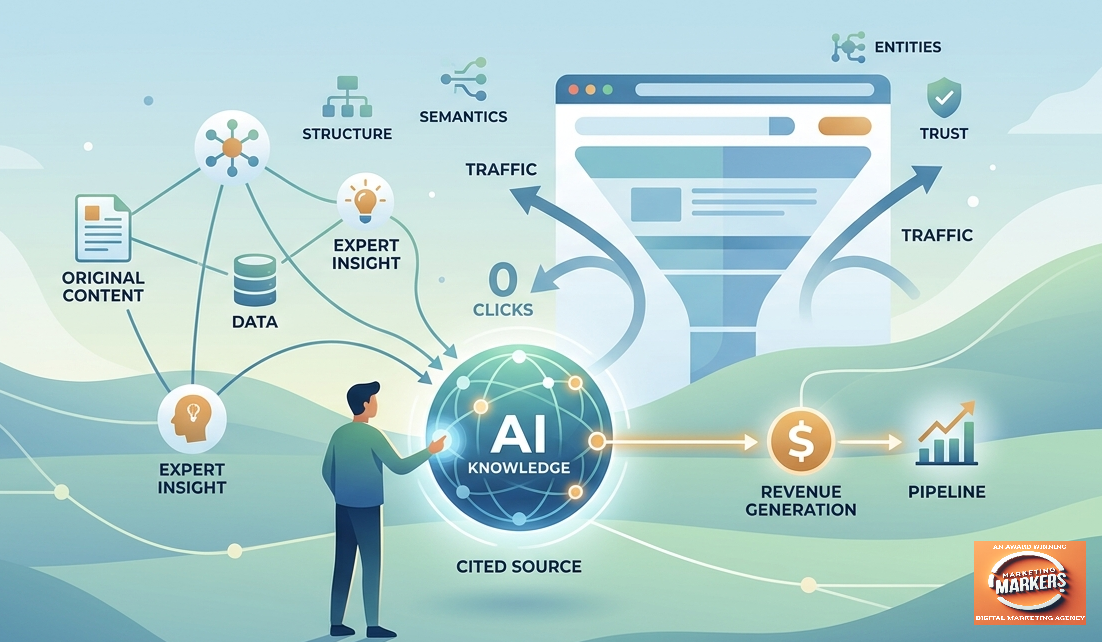
Imagine creating your most valuable, insightful content—content that positions you as the leading authority in your field—yet it never generates a single click to your website. Even more surprising, it still drives revenue and builds your pipeline.
This isn’t some distant technological forecast; it’s our current reality. Platforms powered by generative AI, such as ChatGPT, Perplexity, and Google’s AI Overviews, now deliver immediate answers directly to the user. As a result, the user never needs to leave the search or chat interface to get the information they are looking for.
The Visibility Paradox
This shift creates a new set of challenges for businesses:
- Ranking vs. Traffic: Your search rankings might steadily improve, but your website’s organic traffic may decline.
- Content Consumption Without Conversion: Audiences are interacting with your ideas, but you aren’t capturing them as traditional website visitors.
- The Risk of Invisibility: If an AI model uses your expertise but fails to cite your brand as the source, your hard work goes completely unnoticed.
Adapting to the New Journey
The traditional web funnel, which relied on driving traffic from a search engine to a landing page, is transforming. Because research, discovery, and buying decisions are increasingly happening off-site, businesses must rethink how they establish Professional Authority.
The question is no longer just how to get people to your website, but how to ensure your brand is the recognized, cited authority wherever your audience is looking.
How AI Models Choose Which Brands to Feature
Large Language Models (LLMs) and search engines do not select citations at random. They utilize complex retrieval-augmented generation (RAG) processes that weigh specific trust factors.
To ensure your brand earns the citation, your content must align with the signals these models prioritize:
- Entities Over Keywords: AI systems view the web as a network of entities (people, places, and concepts). Your content must clearly establish relationships between these entities.
- Original Data and Primary Sources: AI models are designed to avoid citing generalized, regurgitated content. By providing original research, expert quotes, or unique statistics, you become the definitive source.
- Clarity and Structure: Content formatted with clear semantic structure (such as bullet points, numbered lists, and direct definitions) is much easier for an AI to extract and use.
The AI-Optimized Content Model
To get cited by AI tools, your content must be optimized for extraction rather than just clicking. Here is how the new content model functions:
[ Core Information ]
│
▼
[ Concise Summary (0-Click Ready) ] ──► (AI Citation)
│
▼
[ Deeper Insights & Conversions ] ──► (Revenue Generation)
1. The 100-Word Rule
Lead with the answer. The first 100 words of your content should address the user’s core query directly, making it easy for an AI model to summarize.
2. Use Structured Formats
Incorporate bulleted lists and numbered steps. AI platforms frequently extract these structured elements to answer instructional and “how-to” queries.
3. Deliver Deeper Value
Provide a quick answer for the AI to extract, but reserve the nuanced, actionable, and proprietary insights for later in the piece. Users who need to implement your strategies or hire your services will still click through for the full context.
Building Authority Beyond Your Website
When search engines reduce the direct traffic to your home page, you must build authority across the broader web ecosystem:
- Digital PR: Secure mentions and citations on trusted industry publications and news websites.
- Knowledge Graph Presence: Make sure your brand is recognized as an entity in Google’s Knowledge Graph and Wikidata.
- Community Engagement: Platforms like Reddit, Quora, and specialized Discord groups are frequently used to train and ground modern AI models.
How to Reach Us:
- Visit our website: https://marketingmarkers.com
Because at Marketing Markers, we know one thing for certain: What gets measured, gets improved.
Suunjaay Kheterpaal is the Chief Digital Strategist at Marketing Markers LLC, leveraging over 25 years of experience at the intersection of IT and high-performance marketing. With dual master’s degrees in computer science and marketing, he specializes in building technical infrastructures where AI-driven efficiency meets human-led strategy. He is a firm believer that “what gets measured gets improved,” focusing on technical SEO and generative search to help businesses scale with precision and authority.