
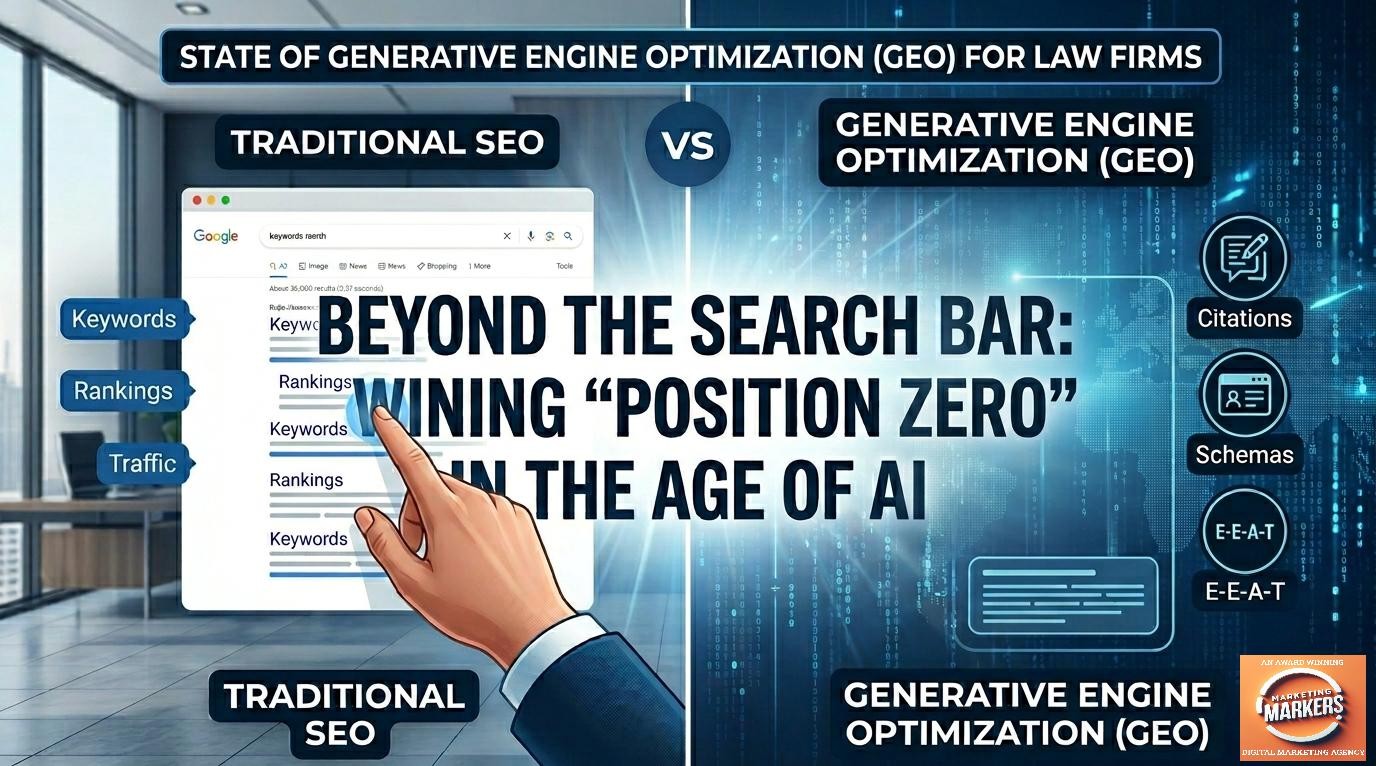
The Legal Marketing Landscape Has Shifted. If your law firm is still obsessing over “blue links” and “ranking #1 on Google,” you’re playing a 2020 game in a 2026 world.
Today, potential clients aren’t just searching—they’re asking. With the rise of AI Overviews, ChatGPT Search, and Perplexity, the goal has evolved from Search Engine Optimization (SEO) to Generative Engine Optimization (GEO).
Here’s the current state of GEO for law firms—and how to ensure your practice remains the “cited authority” in an AI-driven world.
1. From Clicks to Citations: The New Reality
In 2026, “zero-click search” is the standard. AI engines now synthesize answers directly on the results page, often pulling from three or four top-tier sources to create a single, cohesive response.
For a law firm, appearing in the AI summary is the new “Position Zero.”
- The Shift: Traditional SEO focused on driving traffic to your blog. GEO focuses on making your content so authoritative and well-structured that AI models must cite you to be accurate.
- The Impact: While overall traffic may dip, visitors who do click through from AI citations are 4.4x more likely to convert, because the AI has already “vetted” your expertise.
2. Core Strategies for GEO Dominance
To win in 2026, your content must be machine-consumable without losing its human-persuadable edge.
A. The “TL;DR” Executive Summary
AI models (LLMs) prioritize clarity and efficiency. Every practice area page should begin with a concise 2–3 sentence summary.
- Tip: Use a direct answer format. If your heading is “What is the statute of limitations for medical malpractice in Florida?”, your first sentence should be: “In Florida, the statute of limitations for medical malpractice is generally two years from the date of the incident.”
B. Specialized Schema Markup
Schema is no longer just for star ratings. You need advanced structured data so AI understands exactly who you are.
- LegalService & Attorney Schema: Defines your practice areas and credentials
- FAQPage Schema: Highlights Q&A content for AI extraction
- Speakable Schema: Enables voice assistants (Siri, Alexa, Gemini Live) to read your content aloud
C. Moving Beyond Generic Content
AI engines can now detect fluff and low-value content. To be cited, your content must demonstrate E-E-A-T (Experience, Expertise, Authoritativeness, Trust).
- Cite statutes & case law: Use specific legal references
- Add hyper-local nuance: Don’t just write about “car accidents.” Write about specific intersections, courts, or jurisdictions
3. The “Trust Signals” AI Tracks
AI doesn’t just evaluate your website—it analyzes the broader digital consensus about your firm.
- Directory Consistency: Your name, address, and phone number (NAP) must be consistent across platforms like Avvo, Martindale-Hubbell, and your website
- Peer Validation: Mentions on authoritative sites like Best Lawyers or Above the Law act as strong trust signals
- Client Sentiment: AI interprets review context—not just ratings. For example, “John was incredibly responsive during my divorce” signals authority for responsive divorce lawyers
4. Multimodal GEO: Video and Voice
In 2026, AI engines don’t just read—they watch and listen.
- The Strategy: Create short-form “Legal Tip” videos (under 60 seconds) with accurate transcripts and captions
- Why It Works: Video builds human trust while transcripts improve AI visibility
The Verdict: Adapt or Fade
GEO isn’t about gaming an algorithm. It’s about delivering the clearest, most structured, and most authoritative answer to a real legal problem.
Firms that treat AI as a partner—by structuring their data and proving their expertise—will dominate the next decade of client acquisition.