
For decades, local healthcare marketing followed a predictable, comfortable playbook. If you were a dentist looking to fill your chairs with local families, a chiropractor treating chronic back pain, or a podiatrist resolving complex plantar fasciitis, your survival depended on a few transparent local metrics. You claimed your Google Business Profile, optimized for local keywords, collected five-star reviews, and monitored your local map pack position like a hawk.
You won when your practice occupied the top three blue links.
But while medical professionals have been busy running their clinics, the architecture of the internet has completely changed. The metrics you used to rely on—clicks, impressions, and referral traffic—are shifting from clear indicators of performance into a complex, sometimes confusing data landscape. Artificial Intelligence has arrived, not just as a clinical tool to help look at diagnostic scans, but as a silent intermediary standing squarely between prospective patients and your front desk.
The question is no longer how high you rank on Google. The question is: Are you even part of the conversation?
The Extinction of the Traditional Directory Path
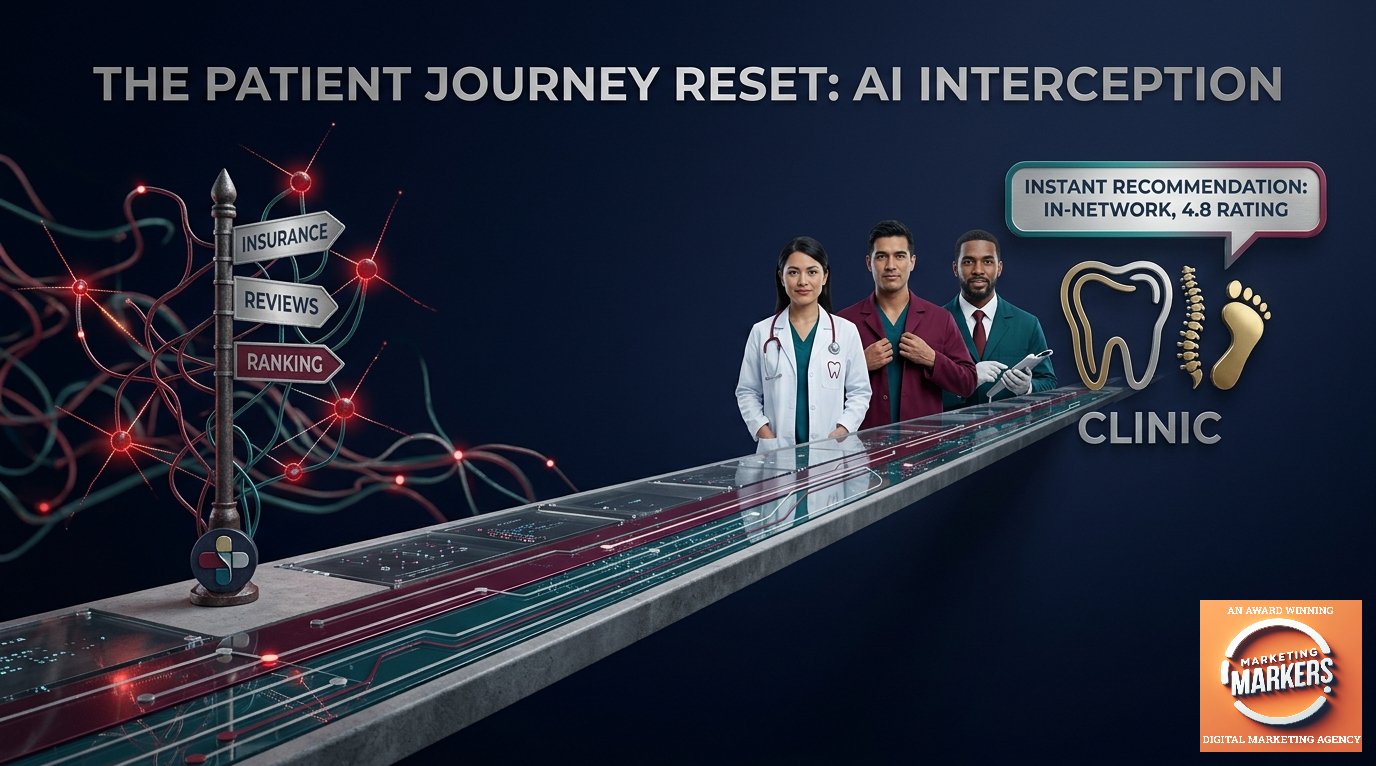
Consider the classic patient behavior model. A prospective patient realizes they need a custom orthotic, an adjustment, or a crown. Historically, their journey involved a clear multi-step loop:
- Log into their health insurance provider portal.
- Filter for an in-network doctor nearby.
- Copy the names of three local clinics.
- Paste them into Google to check reviews, location, and rankings.
- Place the call.
Generative AI models, voice assistants, and Answer Engines are entirely compressing this multi-step path into a single conversational prompt. Modern consumers no longer want to browse endless directories or click back-and-forth between reviews and maps; they expect synthesized answers instantly.
A query like:
“Find an in-network chiropractor near me who specializes in spinal decompression, has at least a 4.8 rating, has free parking, and is open past 6 PM.”
…is no longer broken into separate research phases. The AI absorbs insurance directories, filters live Google maps and review data, reads structured text on websites, and serves a single definitive response.
This is the shift to Position 0. It is no longer about being an option on a page of results; it is about being the absolute answer served directly inside the conversational bubble. If the AI cannot extract a clean, unambiguous verification of your credentials, accepted insurance plans, and precise clinical focus directly from your website’s data infrastructure, your practice is simply bypassed.
“Search Everywhere” vs. Traditional Google SEO
The strategic error many local practices make is operating under the assumption that Google search remains the universal gateway to their office. While Google still commands massive market share, younger demographics—specifically Gen Z and emerging Millennial healthcare decision-makers—exhibit radically decentralized habits.
They are executing “Search Everywhere” behaviors. Before a Gen Z patient schedules a consultation for cosmetic dentistry or chronic heel pain, they treat platforms like Instagram and TikTok as their primary visual search engines.
- They bypass traditional text results to analyze live video testimonials.
- They assess the modern design and cleanliness of your operatory.
- They check your professional demeanor and your staff’s interactions via “day-in-the-life” content.
- They evaluate social proof and community authority directly within their native digital environments.
If your digital marketing strategy is entirely locked into legacy, text-based search engine optimization primarily for Google, you are invisible to an entire generation of affluent new patients.
The Hidden Impact on Practice Analytics
The “dark side” of this rapid technological shift is the widespread confusion it creates for business owners trying to track their digital marketing assets. Traditional KPIs are fracturing. A practice manager might look at their Google Analytics (GA4) dashboard and notice a plateau or a mysterious drop in direct organic website clicks. In the old marketing playbook, this signaled a crisis.
In the new AI-driven landscape, that data can be deeply deceptive. Your practice may actually be cited, weighed, and recommended dozens of times a day inside ChatGPT sessions, custom insurance LLM bots, or Google AI Overviews. This interaction results in direct offline telephone calls or bookings, bypassing your website completely.
Because traditional tracking scripts cannot look inside private AI models, your attribution funnel goes dark. This leaves local doctors vulnerable to making poor strategic decisions based on outdated metrics—such as cutting budgets on assets that are actually feeding the AI engines behind the scenes.
Future-Proofing Your Clinical Practice
Your website matters more today than it ever has before, but its core purpose has fundamentally transitioned. Your site can no longer afford to be a static online brochure; it must function as an open-source database designed for seamless machine ingestion.
To ensure your practice continues to grow rather than get left behind by the generative engine revolution, a complete realignment of your digital strategy is mandatory:
- Structure for Machine Ingestion: Hardcode your accepted insurance networks, clinical specialties, provider credentials, and operational metadata using microdata and JSON-LD schema formats so AI engines can parse your data with 100% accuracy.
- Optimize for Answer Engine Optimization (AEO): Re-engineer your text, FAQs, and service pages to provide clean, direct answers to the complex, contextual queries patients are now typing or speaking into AI assistants.
- Execute an Omnichannel Search Presence: Optimize your content to be found wherever patients ask questions—whether that means structured text for Answer Engines, active local signals for geo-targeted models, or high-authority short-form video on social channels for visual searchers.
The “Zero-Click” era isn’t a dead end for medical practices; it is a forced evolution. The businesses that win in this era will be the ones that stop obsessing over legacy clicks and start focusing on becoming the most trusted, cited, and recognized entity in their field.
Is Your Practice Visible to the Next Generation of Search?
At Marketing Markers, we specialize in helping dentists, chiropractors, podiatrists, and elite local professionals re-engineer their digital footprint for Generative Engine Optimization (GEO). We utilize the foundational rule that “what gets measured gets improved,” updating your KPIs for a privacy-first, AI-driven environment.
Stop chasing yesterday’s clicks. Let’s make sure your practice is the one the AI recommends. Contact Suunjaay Kheterpaal today for a comprehensive AI-readiness audit of your practice’s digital assets.